
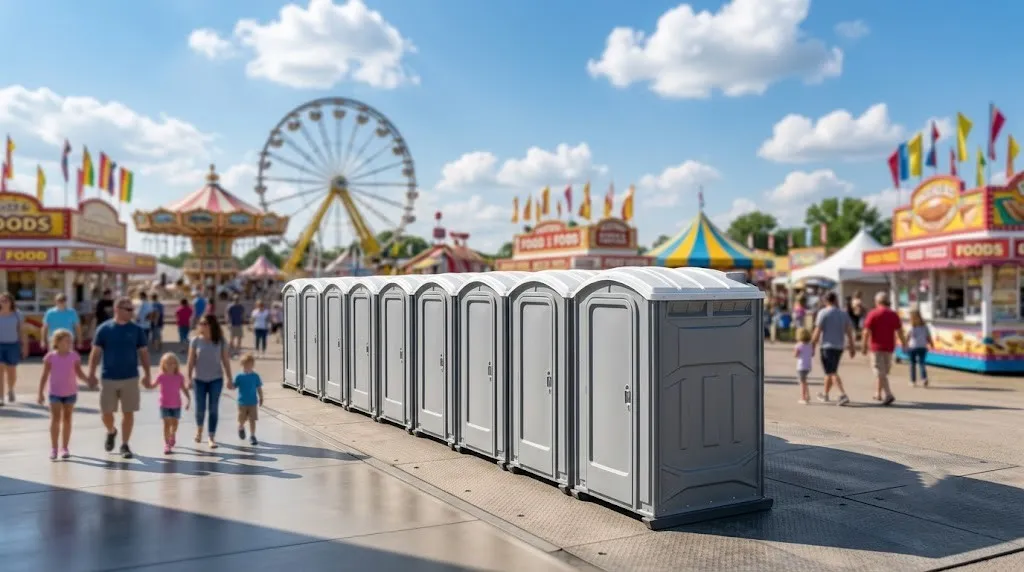
How many restrooms does a county fair need?
Fair crowds spike hard around midday and again at dusk, so the math has to plan for the peak, not the average headcount. OSHA 1926.51(c) sets the construction benchmark at one toilet for every 20 workers, and while a fair is not a job site, that same ratio logic drives how we size public events: more units per attendee than a quiet office crowd, because everyone eats and drinks inside a two or three hour window. A standard porta potty rental works for most of the footprint. Food courts and beer gardens need denser placement, and we always fold in a few deluxe flushable units near the grandstand or main stage where sponsors and VIP guests expect something closer to indoor plumbing. Every cluster needs at least one accessible unit under ADA Standards 213.2, and ADA Standards 405.2 caps ramp slope at 1:12, which matters on the grass and gravel lots most fairgrounds run on. We map ADA accessible porta potty placement against the accessible parking and the main walkways before the tents go up. For multi-day fairs with grandstand entertainment, an 8 stall restroom trailer near the main gate cuts the walking distance for a big share of the crowd and takes pressure off the standard units scattered through the vendor rows. Use our how many porta potties do I need guide to run the numbers against your projected daily gate count before you finalize the layout.
What does a county fair restroom package cost?
Multi-day fairs price out differently than a single Saturday market, and duration changes the math more than most planners expect. A standard unit runs 130 to 500 dollars for a week depending on service frequency and unit count, while an event-rate standard unit for a single fair day typically lands between 200 and 800 dollars. Restroom trailers scale up fast for larger fairs: a week-long trailer rental runs from about 150 to 1,650 dollars depending on stall count, and multi-day trailer events priced at the event rate run 2,499 to 3,899 dollars.
| item | day | week | event |
|---|---|---|---|
| standard unit | 100-350 | 130-500 | 200-800 |
| ADA unit | 200-400 | 120-240 | -- |
| restroom trailer | 175-2500 | 150-1650 | 2499-3899 |
| dumpster (vendor waste) | 51-112 | 426-778 | -- |
Delivery adds a separate line, typically 100 to 500 dollars for a single day or 50 to 150 dollars a week for multi-day setup, and most fair contracts also carry a service fee that runs 30 to 220 dollars a week depending on how often crews need to service the site. Check our porta potty rental cost and monthly porta potty rental pages if your fair runs annually and you want to compare seasonal storage against a fresh delivery each year. Vendor rows generate a lot of cardboard and food waste fast, so most fair organizers add a 10 yard dumpster rental or 20 yard dumpster rental near the food court, and a temporary fence rental around the dumpster pad keeps foot traffic clear.
Why do county fairs need handwashing stations separate from restrooms?
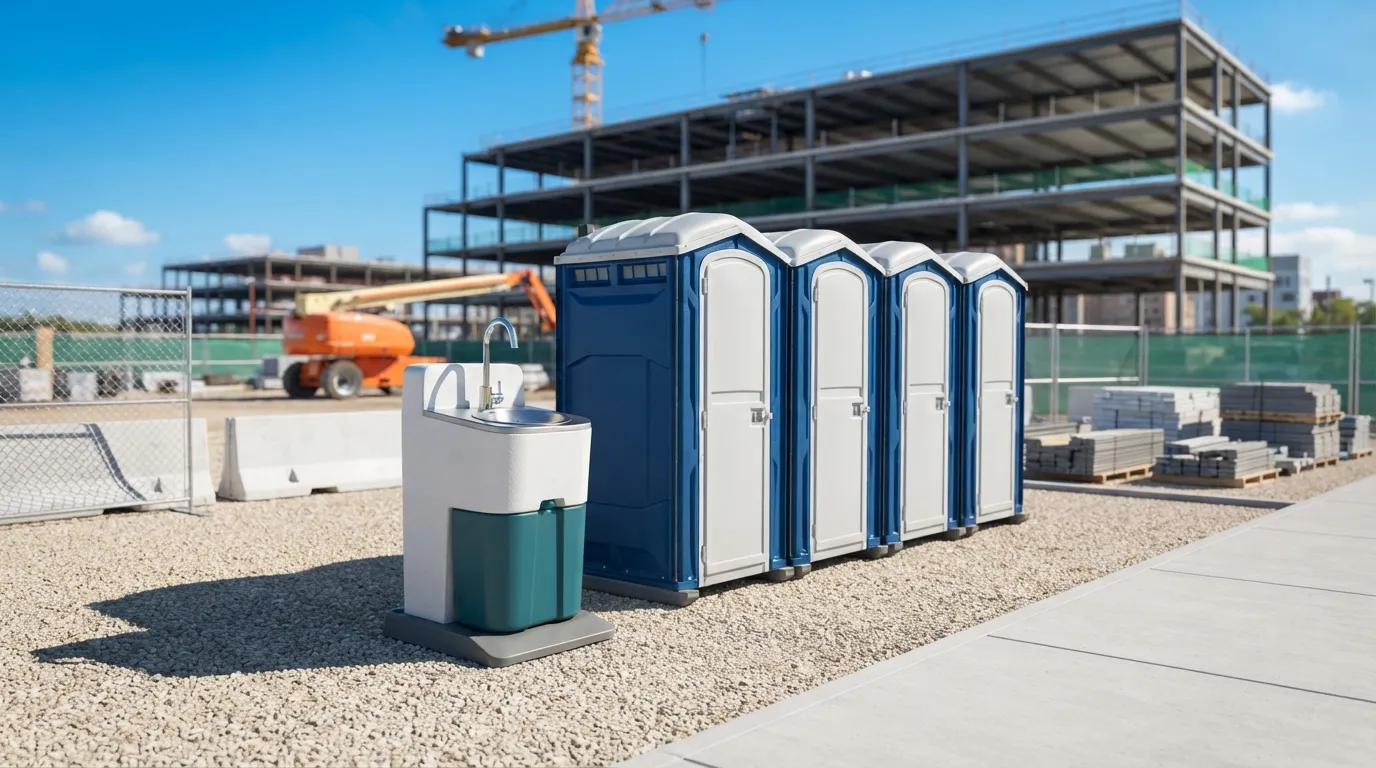
Food vendors change the sanitation math, because 29 CFR 1910.141(d)(2) requires soap and towels or a hand-drying device at washing facilities, and hand sanitizer alone does not satisfy that standard. A fair with a food court needs handwashing station rental units placed at vendor rows, not just inside the restroom clusters, so cooks and servers can wash between tasks without walking across the fairgrounds. If any vendor booth handles cleaning chemicals, coatings, or pesticide displays for a garden exhibit, OSHA 1926.51(f)(1) applies specifically to washing after paints, coatings, herbicides or insecticides, and that booth needs its own station nearby. A portable sink rental works well for smaller vendor clusters that do not need a full multi-basin station. Laguna Niguel fairs on private lots or park grounds should also confirm placement in any public right of way with the city directly, since specific permit rules were not verified for this page; our porta potty permit requirements guide walks through what to ask. For overnight fair setups with lighting needs, a light tower rental and temporary power pole round out the site plan alongside restrooms and handwashing.
Laguna Niguel sits close enough to draw fair traffic and vendor deliveries from Laguna Hills, about 6.0 miles north, and Aliso Viejo, 5.3 miles northwest, so trailers and service trucks often route through both on delivery day. If your fair follows a race or walkathon on the same grounds, see our marathon and race restrooms page for combined layouts. For a fair sharing a weekend with a wedding tent or private event nearby, our event restroom rental hub covers cross-booking logistics. Full county-wide standard packages are on our porta potty rental and portable restroom rental pages.
How far in advance should we book restrooms for a county fair?
Book 60 to 90 days out for a multi-day fair, since trailers and larger unit counts get reserved early. Standard units have more flexibility, but ADA units and trailers sell out first for peak season weekends. Call early if your fair overlaps a holiday.
Do we need a permit for restroom placement at a fairground?
Permit rules vary by lot and by whether restrooms sit in a public right of way, and that has not been verified for Laguna Niguel specifically. Confirm with the city before finalizing your layout. Our porta potty permit requirements page has the questions to ask.
Can we mix standard units and a restroom trailer at the same fair?
Yes, and most multi-day fairs do exactly that. Standard units cover the vendor rows and parking lots, while a trailer near the main stage or grandstand handles higher-traffic hours. See restroom trailer rental for stall options.
How often are restrooms serviced during a multi-day fair?
Service frequency depends on attendance, but ANSI/PSAI Z4.3 sets a baseline of one visit weekly for up to 10 users over a 40 hour week. Multi-day fairs with heavy traffic need daily or twice-daily service instead, especially near food courts.
What happens to vendor waste and cardboard during the fair?
Vendor rows generate steady cardboard and food waste, so most fairs place a dumpster near the food court and route deliveries away from foot traffic. See what cannot go in a dumpster before vendors start tossing grease or oil.
Next step
Get a delivery date
Tell us the address, the dates and the headcount. We size the order and confirm the route.